

Associate 10-10-2026
Choking Under Pressure: What Actually Happens in the Body
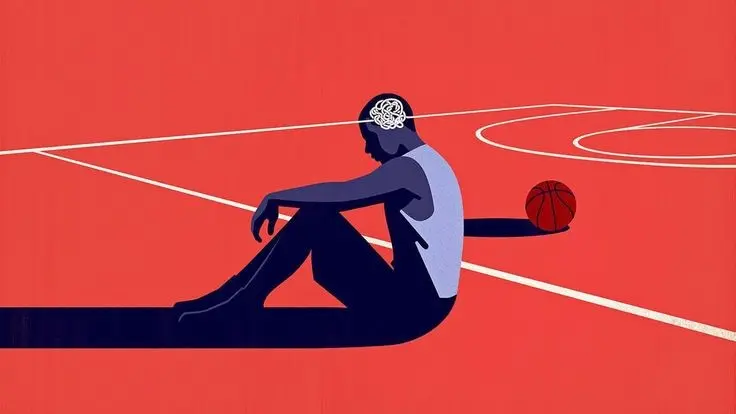
Have you ever known an answer perfectly well, only to forget it the moment someone asks you? Or practiced a presentation ten times, only to stumble over the easiest sentences when everyone is looking at you?
These moments are familiar to most of us. In sports, we call it choking under pressure, when someone performs below their usual level despite having the ability and motivation to succeed (Beilock & Carr, 2001).
The frustrating part is that the athlete has not suddenly lost their skill. They have practiced it repeatedly. So, what changes when pressure arrives?
When Pressure Changes Our Performance
Imagine a basketball player taking a free throw. During training, the movement may be almost automatic. But with the score tied, seconds left and everyone watching, the same player may suddenly become aware of every part of the movement.
“Elbow straight. Keep your wrists relaxed. Don’t miss.”
The more they consciously monitor the movement, the less natural it can feel. This is known as explicit monitoring, where a well-practised skill becomes something the athlete consciously controls, potentially interfering with its smooth execution (Beilock & Carr, 2001).
Pressure can also create distraction:
What if I miss? What will my coach think? Everyone is watching.
Attention shifts away from the task towards worries and consequences. This is known as the distraction account of choking (Mesagno et al., 2015).
It Is Not Just in Your Head
Pressure affects the body as well as the mind.
When a situation is perceived as highly important or threatening, the body’s stress response activates. Heart rate may increase, breathing can change, sweating can increase and muscles may become more tense.
For an athlete performing a precise movement, even small changes in muscle tension or attention can matter. Measures such as heart rate, electrodermal activity and muscle activity can help us understand how an individual responds to pressure, although they cannot, by themselves, tell us that someone is “choking”.
In other words, the mind and body are not working in separate departments.
Why Does Pressure Affect Some Performances More Than Others?
Not every pressure situation leads to choking. Skills requiring fine motor control and precise execution can be particularly vulnerable to excessive conscious control. This is why pressure can be noticeable in activities such as shooting, gymnastics or free throws.
Open-skill sports can be affected differently because athletes constantly respond to changing opponents and environments. Research also suggests that interventions for choking can vary depending on the sporting task (Zeng et al., 2026).
So, telling an athlete to simply “stay calm” is rarely enough. The goal is not to remove pressure, but to learn how to perform effectively while it is there.
So, Can You Train Yourself Not to Choke?
Fortunately, mental skills are skills, and skills can be trained.
A pre-performance routine can help an athlete shift attention towards the task instead of the outcome. Pressure training can also gradually recreate the demands of competition, making pressure something the athlete has experience responding to.
Other approaches include self-talk, mindfulness, imagery and attentional training. Research suggests that several of these interventions can improve performance under pressure, although their effectiveness varies across sporting tasks (Mesagno et al., 2021; Zeng et al., 2026).
There is no universal “anti-choking” technique. What works for one athlete may not work for another.
Where Does Sumona Come In?
This is where understanding the individual becomes important.
At Sumona, the Performance Excellence programme begins with assessment. It looks at psychological and psychophysiological indicators such as stress response, heart rate, muscle tension, reaction time and decision-making time (Sumona, n.d.).
The programme then follows an Assess → Plan → Train → Track approach, allowing training to be personalised. For one athlete, the focus may be attentional control, while another may need to work on physiological regulation, confidence or responding to mistakes during competition.
The point is not to give every athlete the same solution. It is to understand the individual and train the response that needs to change.
Pressure Is Part of Performance
Choking under pressure is often seen as a failure of confidence or mental strength. But pressure can influence attention, self-monitoring, arousal and the execution of well-practised skills (Beilock & Carr, 2001; Mesagno et al., 2015).
The athlete who misses the final shot has not necessarily become less skilled overnight. Sometimes, the challenge is not learning the skill but learning how to access it when it matters most.
Perhaps mental training is not about eliminating pressure, but learning how to perform with it.
References
- Beilock, S. L., & Carr, T. H. (2001). On the fragility of skilled performance: What governs choking under pressure? Journal of Experimental Psychology: General, 130(4), 701–725.
- Mesagno, C., Geukes, K., & Beckmann, J. (2015). Choking under pressure: Theoretical models and interventions. Current Opinion in Psychology, 16, 170–175.
- Zeng, Z., et al. (2026). Counteracting choking under pressure in sport: A meta-analysis of interventions. Psychology of Sport and Exercise, 85, 103130.
- Sumona. (n.d.). Sumona Institute of Performance Excellence.